> For the complete documentation index, see [llms.txt](https://docs.constellationnetwork.io/llms.txt). Markdown versions of documentation pages are available by appending `.md` to page URLs; this page is available as [Markdown](https://docs.constellationnetwork.io/metagraph-development/metagraph-framework/data/lifecycle-functions.md).
# Lifecycle functions
Lifecycle functions are essential to the design and operation of a metagraph within the Euclid SDK. These functions enable developers to hook into various stages of the framework's lifecycle, allowing for the customization and extension of the core functionality of their Data Application. By understanding and implementing these functions, developers can influence how data is processed, validated, and persisted, ultimately defining the behavior of their metagraph.
#### How Lifecycle Functions Fit into the Framework[](https://docs.constellationnetwork.io/sdk/metagraph-framework/data/lifecycle-functions#how-lifecycle-functions-fit-into-the-framework)
In the Euclid SDK, lifecycle functions are organized within the L0 (DataApplicationL0Service), Currency L1 (CurrencyL1App), and Data L1 (DataApplicationL1Service) modules. These modules represent different layers of the metagraph architecture:
* **L0 Layer:** This is the base layer responsible for core operations like state management, validation, and consensus. Functions in this layer are critical for maintaining the integrity and consistency of the metagraph as they handle operations both before (`validateData`, `combine`) and after consensus (`setCalculatedState`).
* **Data L1 Layer:** This layer manages initial validations and data transformations through the /data endpoint. It is responsible for filtering and preparing data before it is sent to the L0 layer for further processing.
* **Currency L1 Layer:** This layer handles initial validations and transaction processing through the /transactions endpoint before passing data to the L0 layer. It plays a crucial role in ensuring that only valid and well-formed transactions are forwarded for final processing. Note that currency transactions are handled automatically by the framework and so only a small number of lifecycle events are available to customize currency transaction handling (`transactionValidator`, etc.).
By implementing lifecycle functions in these layers, developers can manage everything from the initialization of state in the `genesis` function to the final serialization of data blocks. Each function serves a specific purpose in the metagraph's lifecycle, whether it’s validating incoming data, updating states, or handling custom logic through routes and decoders.
#### Lifecycle Overview[](https://docs.constellationnetwork.io/sdk/metagraph-framework/data/lifecycle-functions#lifecycle-overview)
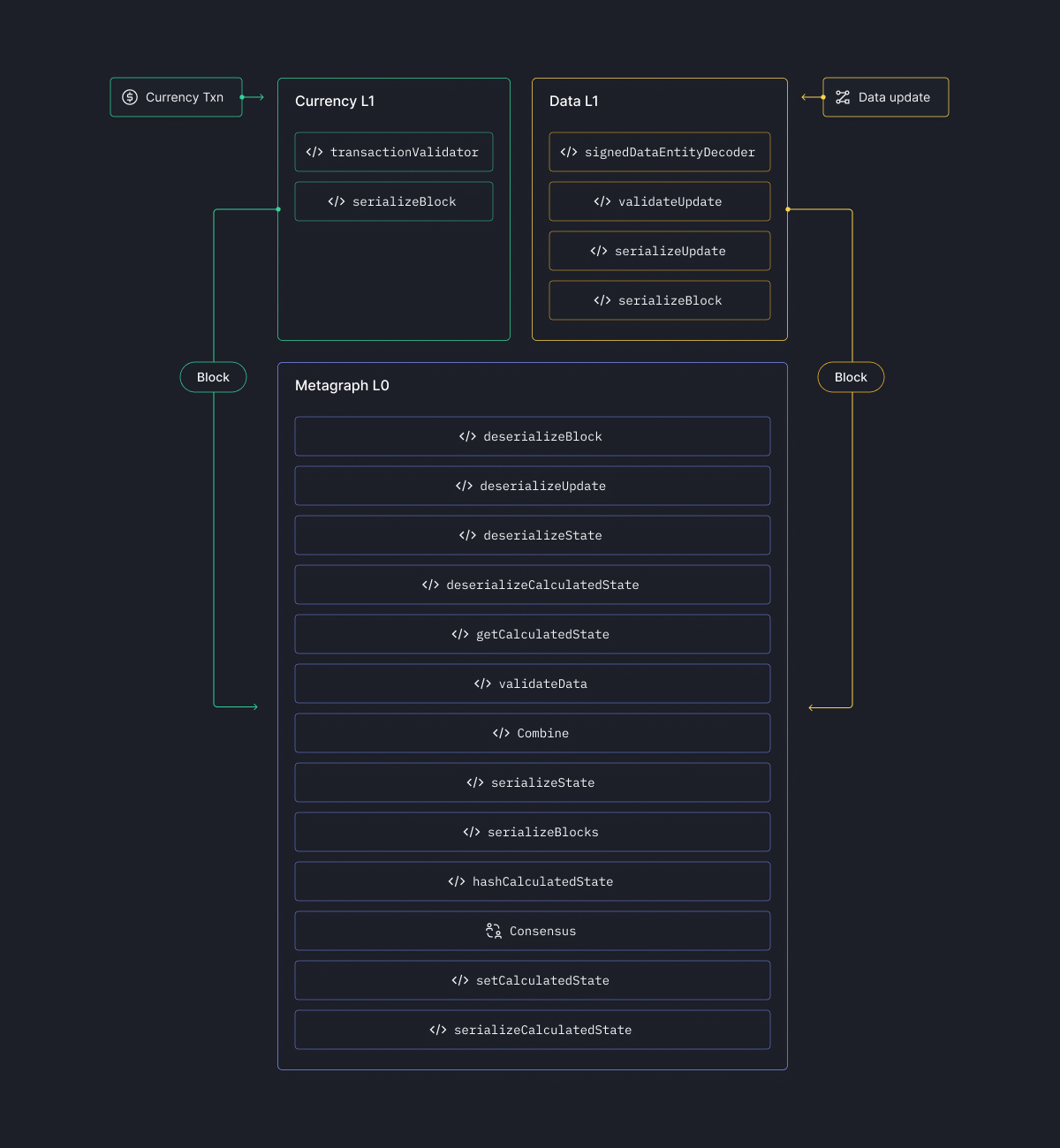
The diagram below illustrates the flow of data within a metagraph, highlighting how transactions and data updates move from the Currency L1 and Data L1 layers into the L0 layer. The graphic also shows the sequence of lifecycle functions that are invoked at each stage of this process. By following this flow, developers can understand how their custom logic integrates with the framework and how data is processed, validated, and persisted as it progresses through the metagraph.
{% hint style="info" %}
Note that some lifecycle functions are called multiple times and across L1 and L0 layers. It is usually recommended to create a common, shared implementation for these functions.
{% endhint %}
### Functions[](https://docs.constellationnetwork.io/sdk/metagraph-framework/data/lifecycle-functions#functions)
#### genesis[](https://docs.constellationnetwork.io/sdk/metagraph-framework/data/lifecycle-functions#genesis)
Data Applications allow developers to define custom state schemas for their metagraph. Initial states are established in the `genesis` function within the `l0` module's `DataApplicationL0Service`. Use the `OnChainState` and `CalculatedState` methods to define the initial schema and content of the application `state` for the `genesis snapshot`.
For example, you can set up your initial states using map types, as illustrated in the Scala code below:
```
class OnChainState(updates: List[Update]) extends DataOnChainState
class CalculatedState(info: Map[String, String]) extends DataCalculatedState
override def genesis: DataState[OnChainState, CalculatedState] = DataState(OnChainState(List.empty), CalculatedState(Map.empty))
```
In the code above, we set the initial state to be:
* `OnChainState`: Empty list
* `CalculatedState`: Empty Map
#### signedDataEntityDecoder[](https://docs.constellationnetwork.io/sdk/metagraph-framework/data/lifecycle-functions#signeddataentitydecoder)
This method parses custom requests at the `/data` endpoint into the `Signed[Update]` type. It should be implemented in both `Main.scala` files for the `l0` and `data-l1` layers. By default, you can use the `circeEntityDecoder` to parse the JSON:
```
{
"value": {
// This type is defined by your application code
},
"proofs": [{
"id": "",
"signature": ""
}]
}
```
The default implementation is straightforward:
```
def signedDataEntityDecoder[F[_] : Async: Env]: EntityDecoder[F, Signed[Update]] = circeEntityDecoder
```
For custom parsing of the request, refer to the example below:
```
def signedDataEntityDecoder[F[_] : Async: Env]: EntityDecoder[F, Signed[Update]] = {
EntityDecoder.decodeBy(MediaType.text.plain) { msg =>
// Assuming msg.body is a comma-separated string of key-value pairs.
val dataMap = msg.body.split(",").map { pair =>
val Array(key, value) = pair.split(":")
key.trim -> value.trim
}.toMap
val update = Update(dataMap.value)
val hexId = Hex(dataMap.pubKey)
val hexSignature = Hex(dataMap.signature)
val signatureProof = SignatureProof(Id(hexId), Signature(hexSignature))
val proofsSet = SortedSet(signatureProof)
val proofs = NonEmptySet.fromSetUnsafe(proofsSet)
Signed(update, proofs)
}
}
```
In this custom example, we parse a simple string formatted as a map, extracting the `value`, `pubKey`, and `signature` necessary to construct the `Signed[Update]`. This method allows for efficient handling of incoming data, converting it into a structured form ready for further processing.
#### validateUpdate[](https://docs.constellationnetwork.io/sdk/metagraph-framework/data/lifecycle-functions#validateupdate)
This method validates the update on the L1 layer and can return synchronous errors through the `/data` API endpoint. Context information (oldState, etc.) is not available to this method so validations need to be based on the contents of the update only. Validations requiring context should be run in `validateData` instead. It should be implemented in both `Main.scala` files for the `l0` and `data-l1` layers
For example, validate a field is within a positive range:
```
def validateUpdate(update: Update): IO[DataApplicationValidationErrorOr[Unit]] = IO {
if (update.usage <= 0) {
DataApplicationValidationError.invalidNec
} else {
().validNec
}
}
```
The code above rejects any update that has the update value less than or equal to 0.
#### validateData[](https://docs.constellationnetwork.io/sdk/metagraph-framework/data/lifecycle-functions#validatedata)
This method runs on the L0 layer and validates an update (data) that has passed L1 validation and consensus. `validateData` has access to the old or current application state, and a list of updates. Validations that require access to state information should be run here. It should be implemented in both `Main.scala` files for the `l0` and `data-l1` layers
For example, validate that a user has a balance before allowing an action:
```
def validateData(oldState: DataState[OnChainState, CalculatedState], updates: NonEmptyList[Signed[Update]]): IO[DataApplicationValidationErrorOr[Unit]] = IO {
updates
.map(_.value)
.map {
val currentBalance = acc.balances.getOrElse(update.address, 0)
if (currentBalance > 0) {
().validNec
} else {
DataApplicationValidationError.invalidNec
}
}
.reduce
}
```
The code above rejects any update that the current balance is lower than 0.
#### combine[](https://docs.constellationnetwork.io/sdk/metagraph-framework/data/lifecycle-functions#combine)
The `combine` method accepts the current state and a list of validated updates and should return the new state. This is where state is ultimately updated to generate the new snapshot state. It should be implemented in both `Main.scala` files for the `l0` and `data-l1` layers
For example, subtract one from a balance map:
```
def combine(oldState: DataState[OnChainState, CalculatedState], updates: NonEmptyList[Signed[Update]]): IO[State] = IO {
updates.foldLeft(oldState) { (acc, update) =>
val currentBalance = acc.balances.getOrElse(update.address, 0)
acc.focus(_.balances).modify(_.updated(update.address, currentBalance - 1))
}
}
```
The code above will subtract one for the given address and update the state
#### serializeState and deserializeState[](https://docs.constellationnetwork.io/sdk/metagraph-framework/data/lifecycle-functions#serializestate-and-deserializestate)
These methods are required to convert the onChain state to and from byte arrays, used in the snapshot, and the OnChainState class defined in the genesis method. It should be implemented in both `Main.scala` files for the `l0` and `data-l1` layers
For example, serialize to/from a State object:
```
def serializeState(state: OnChainState): IO[Array[Byte]] = IO {
state.asJson.deepDropNullValues.noSpaces.getBytes(StandardCharsets.UTF_8)
}
def deserializeState(bytes: Array[Byte]): IO[Either[Throwable, OnChainState]] = IO {
parser.parse(new String(bytes, StandardCharsets.UTF_8)).flatMap { json =>
json.as[OnChainState]
}
}
```
The codes above serialize and deserialize using `Json`
#### serializeCalculatedState and deserializeCalculatedState[](https://docs.constellationnetwork.io/sdk/metagraph-framework/data/lifecycle-functions#serializecalculatedstate-and-deserializecalculatedstate)
These methods are essential for converting the CalculatedState to and from byte arrays. Although the `CalculatedState` does not go into the snapshot, it is stored in the `calculated_state` directory under the `data` directory. For more details, refer to the [State Management](https://docs.constellationnetwork.io/sdk/metagraph-framework/data/state-management) section. It should be implemented in both `Main.scala` files for the `l0` and `data-l1` layers
For example, serialize to/from a State object:
```
def serializeCalculatedState(state: CalculatedState): IO[Array[Byte]] = IO {
state.asJson.deepDropNullValues.noSpaces.getBytes(StandardCharsets.UTF_8)
}
def deserializeCalculatedState(bytes: Array[Byte]): IO[Either[Throwable, CalculatedState]] = IO {
parser.parse(new String(bytes, StandardCharsets.UTF_8)).flatMap { json =>
json.as[CalculatedState]
}
}
```
The codes above serialize and deserialize using `Json`
#### serializeUpdate and deserializeUpdate[](https://docs.constellationnetwork.io/sdk/metagraph-framework/data/lifecycle-functions#serializeupdate-and-deserializeupdate)
These methods are required to convert updates sent to the `/data` endpoint to and from byte arrays. Signatures are checked against the byte value of the `value` key of the update so these methods give the option to introduce custom logic for how data is signed by the client. It should be implemented in both `Main.scala` files for the `l0` and `data-l1` layers
For example, serialize to/from a JSON update:
```
def serializeUpdate(update: Update): IO[Array[Byte]] = IO {
update.asJson.deepDropNullValues.noSpaces.getBytes(StandardCharsets.UTF_8)
}
def deserializeUpdate(bytes: Array[Byte]): IO[Either[Throwable, Update]] = IO {
parser.parse(new String(bytes, StandardCharsets.UTF_8)).flatMap { json =>
json.as[Update]
}
}
```
The codes above serialize and deserialize using `Json`
#### serializeBlock and deserializeBlock[](https://docs.constellationnetwork.io/sdk/metagraph-framework/data/lifecycle-functions#serializeblock-and-deserializeblock)
These methods are required to convert the data application blocks to and from byte arrays, used in the snapshot.\
It should be implemented in both `Main.scala` files for the `l0` and `data-l1` layers
For example, serialize to/from a State object:
```
def serializeBlock(block: Signed[DataApplicationBlock]): IO[Array[Byte]] = IO {
state.asJson.deepDropNullValues.noSpaces.getBytes(StandardCharsets.UTF_8)
}
def deserializeBlock(bytes: Array[Byte]): IO[Either[Throwable, Signed[DataApplicationBlock]]] = IO {
parser.parse(new String(bytes, StandardCharsets.UTF_8)).flatMap { json =>
json.as[Signed[DataApplicationBlock]]
}
}
```
The codes above serialize and deserialize using `Json`
#### setCalculatedState[](https://docs.constellationnetwork.io/sdk/metagraph-framework/data/lifecycle-functions#setcalculatedstate)
This function updates the `calculatedState`. For details on when and why this function is called, refer to the [State Management](https://docs.constellationnetwork.io/sdk/metagraph-framework/data/state-management) section. It should be implemented in both `Main.scala` files for the `l0` and `data-l1` layers
```
override def setCalculatedState(
ordinal: SnapshotOrdinal,
state : CalculatedState
)(implicit context: L0NodeContext[IO]): IO[Boolean] = {
val currentCalculatedState = currentState.state
val updated = state.devices.foldLeft(currentCalculatedState.devices) {
case (acc, (address, value)) =>
acc.updated(address, value)
}
CalculatedState(snapshotOrdinal, CalculatedState(updated))
}.as(true)
```
The code above simply replaces the current address with the new value, thereby overwriting it.
#### getCalculatedState[](https://docs.constellationnetwork.io/sdk/metagraph-framework/data/lifecycle-functions#getcalculatedstate)
This function retrieves the `calculatedState`. It should be implemented in both `Main.scala` files for the `l0` and `data-l1` layers
```
override def getCalculatedState(implicit context: L0NodeContext[IO]): IO[(SnapshotOrdinal, CheckInDataCalculatedState)] =
currentState.state.map(calculatedState => (calculatedState.ordinal, calculatedState.state))
```
The code above is an example of how to implement the retrieval of `calculatedState`.
#### hashCalculatedState[](https://docs.constellationnetwork.io/sdk/metagraph-framework/data/lifecycle-functions#hashcalculatedstate)
This function hashes the `calculatedState`, which is used for `proofs`. It should be implemented in both `Main.scala` files for the `l0` and `data-l1` layers
```
override def hashCalculatedState(
state: CalculatedState
)(implicit context: L0NodeContext[IO]): IO[Hash] = {
val jsonState = state.asJson.deepDropNullValues.noSpaces
Hash.fromBytes(jsonState.getBytes(StandardCharsets.UTF_8))
}
```
The code above is an example of how to implement the hashing of `calculatedState`.
#### dataEncoder and dataDecoder[](https://docs.constellationnetwork.io/sdk/metagraph-framework/data/lifecycle-functions#dataencoder-and-datadecoder)
Custom encoders/decoders for the updates. It should be implemented in both `Main.scala` files for the `l0` and `data-l1` layers
```
def dataEncoder: Encoder[Update] = deriveEncoder
def dataDecoder: Decoder[Update] = deriveDecoder
```
The code above uses the `circe` semiauto deriveEncoder and deriveDecoder
#### calculatedStateEncoder and calculatedStateDecoder[](https://docs.constellationnetwork.io/sdk/metagraph-framework/data/lifecycle-functions#calculatedstateencoder-and-calculatedstatedecoder)
Custom encoders/decoders for the calculatedStates. It should be implemented in both `Main.scala` files for the `l0` and `data-l1` layers
```
def calculatedStateEncoder: Encoder[CalculatedState] = deriveEncoder
def calculatedStateDecoder: Decoder[CalculatedState] = deriveDecoder
```
The code above uses the `circe` semiauto deriveEncoder and deriveDecoder
[Edit this page](https://github.com/Constellation-Labs/documentation-hub/edit/main/sdk/metagraph-framework/05-data/03-lifecycle-functions.md)
---
# Agent Instructions
This documentation is published with GitBook. GitBook is the documentation platform designed so that both humans and AI agents can read, navigate, and reason over technical content effectively. Learn more at gitbook.com.
## Querying This Documentation
If you need additional information that is not directly available in this page, you can query the documentation by asking a question.
Perform an HTTP GET request on the following URL with the `ask` and `goal` query parameters:
```
GET https://docs.constellationnetwork.io/metagraph-development/metagraph-framework/data/lifecycle-functions.md?ask=&goal=
```
`ask` is the immediate question: it should be specific, self-contained, and written in natural language.
`goal` is what the user is ultimately trying to achieve, the reason they need the answer. Sharing it helps GitBook give you a better, more relevant answer. A goal is most helpful when it describes the outcome the user wants rather than restating the question. For example, with `ask=how do I create an API token`, a goal like `automate deployments from our CI pipeline` lets GitBook tailor the answer to that use case.
The response will contain a direct answer to the question and relevant excerpts and sources from the documentation.
Use this mechanism when the answer is not explicitly present in the current page, you need clarification or additional context, or you want to retrieve related documentation sections.